
Words look harmless until they trip you up in public writing.
Shiney vs shiny does exactly that.
You’ve probably seen both spellings floating around emails, captions, even product listings. One looks right at a glance. The other sneaks in quietly. However, only one spelling holds up in standard English.
Let’s clear the confusion once and for all.
No fluff. No grammar lectures. Just clear answers, real examples, and practical advice you can use today.
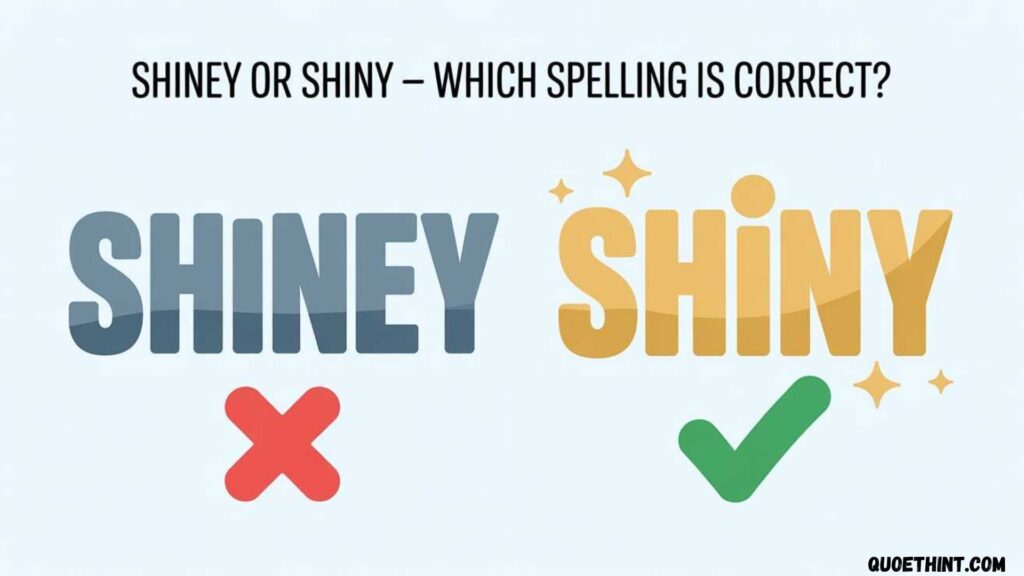
Is It Shiny or Shiney? The Short Answer

The correct spelling of shiny is shiny.
Shiney is considered an incorrect spelling of shiny in modern English.
That’s the rule.
Now let’s explain why it exists.
Why “Shiny” Is Correct in Standard English
English loves patterns, even if it pretends otherwise.
One of those patterns shows up when forming adjectives.
The word shiny comes from the verb shine.
To create an adjective, English often adds the suffix “-y.”
Here’s the key point:
- Shine + y = shiny
- Not shine + ey
This follows common English spelling rules for verb-to-adjective conversion.
Similar examples you already know
- Fog → foggy
- Mess → messy
- Cloud → cloudy
- Grease → greasy
Notice the pattern.
The base word adjusts slightly. The spelling stays clean.
That’s why shiney breaks spelling conventions and looks off to trained readers.
Why Do People Still Write “Shiney”?
Good question.
And honestly, it’s understandable.
Here’s what usually causes the mistake:
- The base word ends in “e”
- Words like bone → boney exist
- Autocorrect doesn’t always catch it
- Visual similarity tricks the eye
So people assume shine → shiney must work the same way.
It doesn’t.
English spelling loves exceptions.
This one just happens to be strict.
Shiny vs Shiney: Side-by-Side Comparison
| Feature | Shiny | Shiney |
|---|---|---|
| Standard English | ✅ Yes | ❌ No |
| Dictionary accepted | ✅ Yes | ❌ No |
| Professional writing | ✅ Recommended | ❌ Avoid |
| Academic use | ✅ Correct | ❌ Incorrect |
| Perceived credibility | ✅ High | ❌ Lower |
Small difference. Big impact.
Meaning and Usage of “Shiny”
The word shiny describes something that reflects light well.
Think glossy appearance, polished appearance, or visible light reflection.
It often refers to:
- Reflective surfaces
- Glistening objects
- Smooth textures
- Clean finishes
Common correct phrases
- shiny hair
- shiny surface
- shiny appearance
- shiny shoes
Each one fits naturally in professional and casual writing.
Incorrect Usage Examples (What to Avoid)
These phrases appear often online.
They’re still wrong.
- “shiney surface”
- “shiney hair”
- “The car looks shiney after the wash”
Readers may understand the meaning.
However, spelling accuracy affects trust more than most people realize.
Why Spelling Matters More Than You Think
Spelling isn’t just decoration.
It signals attention to detail.
In many settings, small errors change how your message lands.
Where spelling mistakes hurt most
- Professional emails
- Resumes
- Reports
- Academic assignments
- Product descriptions
- Exams and assessments
One misspelled word can quietly reduce writing credibility and perceived expertise.
Email Scenario: Shiny vs Shiney in Professional Writing
❌ Incorrect Email Example
Subject: Product Finish Review
Hi Karen,
The new table has a shiney surface that customers will notice immediately.
Let me know if we should adjust the coating.Best,
Daniel
It’s readable.
But the misspelling signals carelessness.
✅ Correct Email Example
Subject: Product Finish Review
Hi Karen,
The new table has a shiny surface that customers will notice immediately.
Let me know if we should adjust the coating.Best,
Daniel
Same message.
More professional writing standards.
Educational Scenario: Exams and Assignments
Teachers and examiners notice spelling patterns fast.
Using shiney can cost points even if the idea is solid.
❌ Student Sentence
The scientist observed a shiney material under direct light.
✅ Corrected Sentence
The scientist observed a shiny material under direct light.
This change improves clarity in writing and aligns with English language accuracy.
Resume and Cover Letter Example
Hiring managers scan quickly.
Errors stand out.
❌ Resume Bullet
- Designed packaging with a shiney finish to attract buyers
✅ Improved Version
- Designed packaging with a shiny finish to attract buyers
Small fix.
Stronger impression.
Product Description Scenario
Online shoppers judge credibility fast.
Spelling errors raise doubts.
❌ Product Listing
This handbag features a shiney exterior with durable stitching.
✅ Correct Version
This handbag features a shiny exterior with durable stitching.
Clear. Polished. Trustworthy.
That’s effective communication at work.
Is “Shiney” Ever Acceptable?
In modern standard spelling usage, no.
You might see shiney in:
- Very old texts
- Informal social posts
- Unedited comments
However, it doesn’t belong in professional writing, education, or polished content.
If you care about readability and accuracy, skip it.
How to Remember the Correct Spelling
Here’s a simple mental trick.
Think of rainy, sunny, windy.
None add extra letters.
Neither does shiny.
Short. Clean. Correct.
Common Spelling Mistakes Related to “Shiny”
Writers often struggle with words formed from verbs.
Examples include:
- shiny vs shiney
- icy vs icey
- greasy vs greasey
These fall under commonly misspelled words because English doesn’t always behave logically.
Knowing the rule helps you avoid repeated spelling errors in English.
Why This One Word Impacts Writing Credibility
Readers may not explain it out loud.
They still feel it.
Correct spelling signals:
- Care
- Competence
- Authority
- Respect for the reader
That’s why spelling matters, especially when your writing represents you.
Key Takeaways You Can Use Immediately
Let’s lock it in.
- Shiny is the standard form
- Shiney is a nonstandard form
- Use shiny in all professional and academic contexts
- Spelling supports clear communication
- Accuracy boosts professional credibility
Once you notice it, you’ll never unsee it.
Final Thought
English can feel slippery.
Words shine until they trip you.
Choosing shiny over shiney is a small decision.
It still carries weight.

Bugti is the founder of Quoethint.com, a hub for English language tips, writing advice, and grammar guidance. With years of experience in English studies and a passion for clear communication, Bugti created this platform to make grammar and writing easy to understand for everyone.