If you’ve ever paused mid-sentence while typing a grocery list or an email, you’re not alone. The confusion between potatoes or potatos trips up writers every day. It looks harmless. It sounds logical. However, only one spelling works in standard English. The other quietly sneaks in as a common mistake.
Let’s clear the fog once and for all. By the end of this guide, you’ll know the correct plural of potato, why the rule exists, and how to avoid this error forever. You’ll also see real-world examples, from emails to menus, so everything sticks naturally.
Which Is Correct: Potatoes or Potatos?
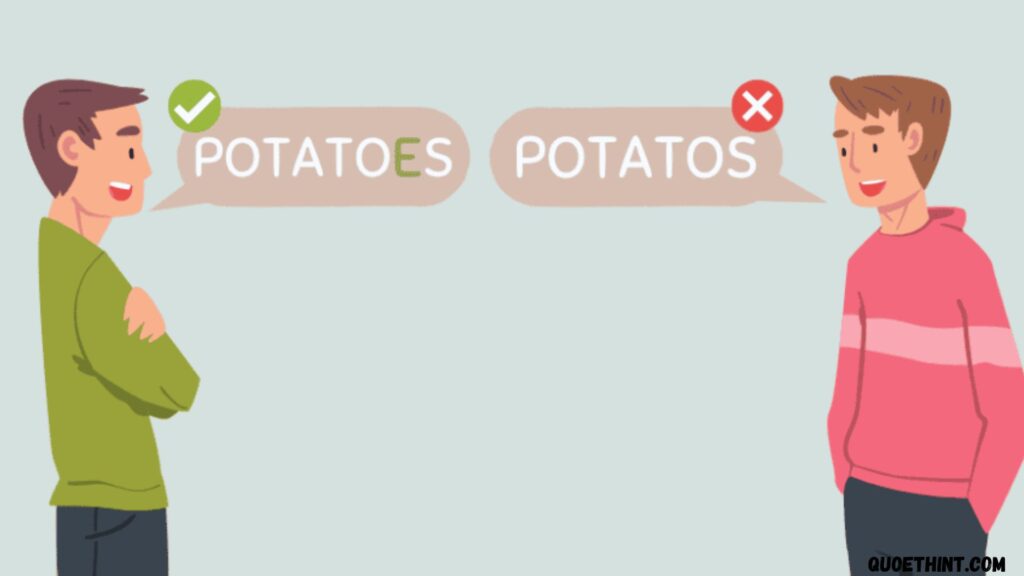
Here’s the short answer you can memorize and move on with confidence:
👉 “Potatoes” is correct. “Potatos” is incorrect.
The word potatos is considered a misspelling of potatoes and does not appear in reputable dictionaries as an accepted plural form. If you’re wondering is it potatos or potatoes, the answer never changes.
Always write: potatoes.
Why “Potatoes” Is the Correct Plural Form
The explanation sits squarely inside English pluralization rules. Specifically, it involves nouns ending in -o.
The Core Rule That Matters
When a countable noun ends with a consonant + o, English usually forms the plural by adding -es.
That’s exactly what happens here:
- potato → potatoes
- hero → heroes
- echo → echoes
- tomato → tomatoes
This pattern explains the plural form of potato and answers the question what is the plural of potato with zero ambiguity.
Why “Potatos” Feels Right (But Isn’t)
Spelling confusion often comes from sound. When spoken, “potato” ends cleanly. Your brain wants to add a simple -s, just like cats or books. That instinct creates a phonetic spelling error.
However, English doesn’t always follow sound-based logic. It follows convention.
That’s why potatos looks reasonable but remains the incorrect spelling of potatos every single time.
Potatoes vs Potatos: Side-by-Side Comparison
Here’s a quick visual cue that helps cement the difference.
| Form | Correct? | Why It Works (or Doesn’t) |
|---|---|---|
| potatoes | ✅ Yes | Follows consonant + o → -es rule |
| potatos | ❌ No | Breaks standard English spelling rules |
If you ever hesitate, remember this table. It acts as a built-in memory aid.
Everyday Scenarios That Show the Difference
Seeing grammar rules in real-life contexts makes them easier to remember. Let’s walk through a few familiar situations.
Scenario 1: A Work Email
Incorrect Version:
Hi Sarah,
Please add potatos to the catering order for tomorrow’s meeting.
Thanks,
Mark
This version contains a common spelling mistake that can subtly undermine professionalism.
Correct Version:
Hi Sarah,
Please add potatoes to the catering order for tomorrow’s meeting.
Thanks,
Mark
One small change. Big difference in clarity and credibility.
Scenario 2: A Grocery List
You’re texting your partner before dinner.
Incorrect:
Don’t forget onions, milk, and potatos.
Correct:
Don’t forget onions, milk, and potatoes.
This is classic everyday language, where spelling slips happen most often.
Scenario 3: A Restaurant Menu
Menus demand precision. Misspellings stand out fast.
Incorrect:
Garlic roasted potatos with herbs
Correct:
Garlic roasted potatoes with herbs
In a culinary context, spelling accuracy shapes customer trust.
Why English Uses “-es” for Potato
The rule isn’t random. It has historical roots tied to pronunciation clarity and language evolution.
The word potato comes from Spanish “patata.” When English adopted it, the plural followed the pattern already established for similar nouns. Over time, standard English usage locked in potatoes as the only accepted form.
That’s why dictionary definitions never list “potatos” as valid.
Common Questions People Ask (Answered Clearly)
Is It Potatos or Potatoes?
It’s always potatoes. No exceptions.
How Do You Spell Potatoes?
P-O-T-A-T-O-E-S.
What Is the Plural of Potato?
The plural of potato is potatoes.
Is Potatos Ever Accepted?
No. It’s considered a misspelling of potatoes in all formal and informal writing.
Why This Mistake Keeps Appearing Online
Search data shows people constantly typing:
- potatoes vs potatos
- plural for potato
- potato plural spelling
Why? Because English includes exceptions. Words like pianos and photos only add -s, which muddies the waters.
However, potato grammar rules fall firmly on the -es side. Treat it like tomato. That parallel helps instantly.
A Simple Mnemonic That Actually Works
Here’s a quick mnemonic device you can keep in your back pocket:
If it grows underground and ends in “-o,” it usually grows an “-es.”
It’s quirky. It’s visual. And it sticks.
Potatoes in Writing Contexts
Correct spelling matters more than people admit. Here’s where it shows up most:
- Recipes: mashed potatoes, diced potatoes
- Academic writing: agricultural studies, nutrition papers
- Menus: sweet potatoes, garlic roasted potatoes
- Emails: catering orders, meal planning
- Everyday notes: shopping lists, reminders
In all these cases, spelling potatoes correctly protects clarity and credibility.
Formal Writing vs Informal Writing
You might wonder if casual writing allows flexibility. It doesn’t.
Whether you’re drafting a research paper or texting a friend, potatos still counts as incorrect. English spelling rules don’t relax based on tone.
Why This One Word Matters More Than You Think
Spelling errors rarely stand alone. Readers subconsciously link them to carelessness. That’s why mastering small details like potato plural spelling improves overall writing accuracy.
It’s not about perfection. It’s about trust.
Final Takeaway: The Rule You’ll Never Forget
Let’s lock it in one last time:
- ✅ Potatoes — correct plural form
- ❌ Potatos — not recognized spelling
If the word ends in a consonant + o, add -es. Simple. Reliable. Done.
Once you internalize this rule, the confusion disappears. No second-guessing. No spell-check anxiety. Just clean, confident writing that reads naturally every time.

Bugti is the founder of Quoethint.com, a hub for English language tips, writing advice, and grammar guidance. With years of experience in English studies and a passion for clear communication, Bugti created this platform to make grammar and writing easy to understand for everyone.