Texting changed fast over the last decade. New acronyms pop up daily. Older slang takes on fresh meanings. People communicate in shorter bursts and they often rely on shorthand to move conversations quickly. That speed feels convenient yet it can also create confusion especially when you see a three letter acronym that carries more than one meaning.
One of the most common questions from readers in 2025 is simple: what does TMB mean in text. You see it in group chats at work. You see it in short replies from friends. You might even see it in comments on social platforms. The problem shows up when a reader assumes one meaning while the sender meant something else. Misunderstandings happen easily because tone disappears inside digital conversations.
This guide solves that problem with clear definitions real examples and a deep look at better alternatives. You get everything you need to understand TMB in any context so your communication stays sharp and respectful.
Why TMB Confuses So Many People in 2025

People encounter TMB in dozens of situations now. You might see it inside fast text exchanges after work. You might find it in gaming chats. You might even find TMB inside industry channels for finance or tech. With many acronyms you can guess the meaning from the sentence yet TMB tricks many readers because it works in casual settings and professional situations.
Messaging habits shifted during the past year. Short forms became popular again because people type faster on smaller screens. Social platforms encourage quick replies which pushes acronyms back into mainstream use. That rise created fresh confusion especially for people who prefer clarity over abbreviations.
This article helps you understand what TMB means and how to decode it with zero stress. You also learn when it creates problems and how to replace it with something cleaner.
The Primary Meaning of TMB in Text
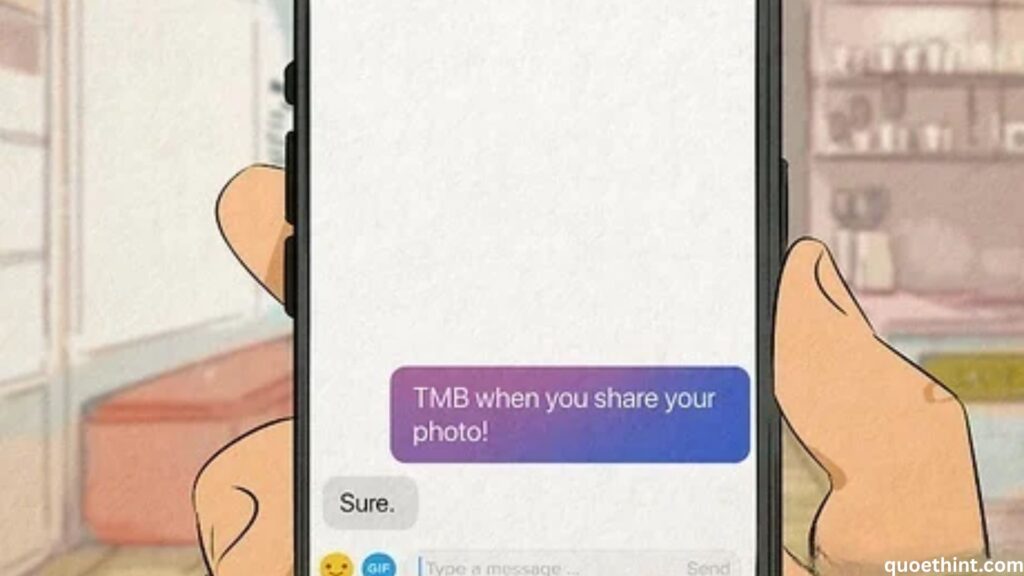
Readers ask what does TMB mean in text more than any other acronym question this year. The most accurate and most used definition is Text Me Back. That simple phrase explains the intent clearly. Senders use it when they want a reply. It saves time and it pushes the conversation forward without requiring a full sentence.
How the Primary Meaning Works
TMB functions as a small request. It carries expectation yet it rarely sounds demanding when used with people who already know you well. The meaning feels direct which is why many use it with close contacts.
Examples of the Primary Use
Casual tone:
- “I’m heading into the store TMB when you see my message.”
- “I’ll send the file in a minute TMB after you check it.”
Friendly tone:
- “TMB after practice so we can plan dinner.”
- “Got your message yesterday TMB when you wake up.”
Quick update:
- “Just parked TMB once you get here.”
- “I’m done with my shift TMB if you still need help.”
People type TMB to close a thought without writing a long follow up. The ease makes it popular among teens and young adults who move through conversations quickly.
Secondary Meanings You Must Know in 2025
The main definition dominates texting culture yet other meanings appear in specific environments. You asked what do TMB mean in text because one acronym holds multiple interpretations. This section protects you from misreading each version.
TMB as “Too Many Bugs” (Tech and Gaming)
Developers gamers and testers use TMB to describe a buggy app or unstable program. You might see this meaning inside Discord servers Slack groups or development channels.
Example:
- “This patch still has TMB we need another debug pass.”
- “I tested the new mod TMB so I rolled it back.”
TMB as “That Might Be…” (Workplace shorthand)
Corporate teams sometimes shorten phrases to move faster through discussions. Analysts and managers use TMB to propose a possibility during brainstorms or planning meetings.
Example:
- “TMB the best solution if budget stays tight.”
- “TMB our only option until we get final numbers.”
TMB in Finance as Tampa Municipal Bond
Finance professionals sometimes reference a specific bond class or security using shorthand. This rarely appears in casual chat so you can often rule it out unless you work in finance.
Example:
- “Client wants to diversify TMB fits the low risk bracket.”
These extra definitions show why context matters. Jumping to the wrong meaning creates confusion especially in professional settings.
How Context Changes the Meaning of TMB
The real challenge comes from tone. Words inside digital messages lose emotional cues. If someone types TMB without punctuation you must read it inside the frame of the entire conversation. This section helps you decode it quickly.
Contextual Clues
Here are the main signals that reveal which TMB meaning applies:
- Relationship
Close friends use the phrase casually. Coworkers use it more formally. - Message pace
If the sender replies fast TMB probably means Text Me Back.
If the conversation involves planning or speculation the meaning may shift. - Setting
Gaming channels often use TMB for “Too Many Bugs”.
Workplace threads sometimes use it as “That Might Be…”.
Examples of Context Changes
Neutral update:
- “I’m driving rn TMB.”
Meaning: They want you to reply later.
Urgent tone:
- “Call dropped TMB asap.”
Meaning: They need information quickly.
Casual tone:
- “Finished eating TMB when you’re done.”
Meaning: They want to reconnect soon.
Understanding tone guards you from mistaken assumptions.
When You Should Avoid TMB Entirely
Every acronym carries risk in certain settings. Even when someone knows what tmb mean in text the delivery might sound cold or abrupt. Some readers see TMB as impatient especially when the message lacks warmth. Consider skipping TMB in these situations.
Professional Environments
Teams value clarity. Acronyms slow comprehension when everyone reads them differently. A simple phrase outperforms shorthand because it keeps communication clear.
Sensitive Conversations
Friendships and partnerships require nuance. Short forms weaken tone and they sometimes sound harsh.
First-Time Interactions
When someone does not know you they cannot interpret your shorthand easily and misinterpretation feels likely.
Formal Clients or Cross-Team Chats
You gain more trust with clear complete messaging.
Avoiding TMB in these environments helps you communicate with more empathy and more precision.
Better Alternatives to TMB in 2025
Readers searching for tmb meaning in text often want better ways to communicate. This section delivers twelve alternatives that outperform TMB because they add clarity comfort and tone. Each phrase includes an example and a best use case.
Let me know when you’re free
Perfect for friendly updates or planning.
Example:
“Let me know when you’re free so I can send the draft.”
Looking forward to your reply
Polite and useful in professional settings.
Example:
“I shared the report earlier looking forward to your reply.”
Ping me back when you can
Casual and ideal for colleagues.
Example:
“Ping me back when you can the server log looks strange.”
Just give me a quick reply when you’re available
Direct yet warm.
Example:
“Just give me a quick reply when you’re available I have a small question.”
Get back to me when you’re ready
Softens pressure effectively.
Example:
“Get back to me when you’re ready and we can finalize the details.”
Let’s catch up soon drop me a line when you can
Friendly and versatile.
Example:
“Let’s catch up soon drop me a line when you can I want to share something fun.”
Feel free to respond when you’re free
Gentle and respectful of someone’s time.
Example:
“Feel free to respond when you’re free no rush at all.”
Hope to hear from you soon
Ideal when sending updates.
Example:
“I attached the files hope to hear from you soon.”
Reply whenever it’s convenient
Warm and flexible.
Example:
“Reply whenever it’s convenient your schedule matters.”
Shoot me a quick text when you’re good
Smooth and casual.
Example:
“Shoot me a quick text when you’re good I’ll be around.”
Drop me a message when you get a sec
Relaxed and friendly.
Example:
“Drop me a message when you get a sec so we can confirm details.”
Let’s reconnect soon message me anytime
Open and inviting.
Example:
“Let’s reconnect soon message me anytime you’re free.”
These replacements create clarity because they remove ambiguity and support smoother conversations.
Comparison Table: TMB vs Better Alternatives
This table helps you choose the best message based on tone and situation.
| Phrase | Tone | Best Context | Emotional Signal |
|---|---|---|---|
| TMB | Direct | Fast casual chats | Expectation of a reply |
| Let me know when you’re free | Friendly | Planning and coordination | Considerate and open |
| Ping me back when you can | Casual | Work or teamwork threads | Light and collaborative |
| Reply whenever it’s convenient | Polite | Professional or formal | Respect for time |
| Drop me a message when you get a sec | Warm | Friends or close colleagues | Casual connection |
Why Many People Skip TMB Now
People who ask what does tmb mean in text often want to know whether it still fits into modern communication. Some avoid it for these reasons.
Perception of Abruptness
Short forms cut emotional tone away. Some readers see TMB as impatient.
Generational Differences
Younger users often lean on shorthand. Older users prefer clarity which can clash inside mixed age conversations.
Ambiguity
Since TMB carries several meanings readers guess incorrectly and misunderstandings follow.
Larger Cultural Shift
People now value tone more because text messages represent emotional signals. Clearer messages create smoother communication.
These factors push many toward explicit alternatives.
When TMB Still Works Perfectly Fine
Even if some avoid it you can still use TMB naturally when:
- You speak with someone who already uses acronyms.
- You need to respond quickly during a busy moment.
- The conversation feels low stakes.
- Both parties want fast messaging over full sentences.
TMB fits well when the relationship already supports shorthand. It saves time and it keeps conversations moving.
Mini Etiquette Guide: How to Ask for a Reply Without Sounding Pushy
A gentle approach improves response rates. If you wonder what tmb mean in text you probably want to communicate more clearly. These small etiquette notes help you ask for a reply gracefully.
Use Warmth
Kind phrasing makes a message feel lighter.
Avoid Double Messaging
A second message creates pressure. Give space.
Use Softeners
Phrases like “when you get the chance” reduce tension.
Follow Message Pace
If someone responds slowly match that rhythm so the conversation feels balanced.
Keep Expectations Realistic
People manage different schedules. Respect the variation.
Simple etiquette creates more positive exchanges.
Case Study: How TMB Creates Misunderstandings
This short scenario shows why context matters.
Situation:
A project coordinator messages a designer:
“Finished reviewing the draft TMB.”
The coordinator meant “Text Me Back.”
The designer interpreted TMB as “That Might Be…” which muddled the conversation.
Result:
The designer waited for clarification thinking the coordinator meant a suggestion.
The coordinator waited for a reply thinking the designer ignored the message.
Fix:
Clearer language avoids delays. A full phrase increases efficiency and reduces confusion.
Case Study: How TMB Works Perfectly With the Right Person
In another scenario two close friends use shorthand often. One sends:
“Just reached your street TMB.”
They both know it means “Text Me Back.”
The message fits their communication style.
The response comes instantly and the conversation flows easily.
Context protects communication and supports shared understanding.
The Final Takeaway: Clearer Communication Beats Shorthand Every Time
People search for tmb text meaning because they want clean communication inside a fast digital world. Acronyms feel fast yet they lose tone. When clarity matters choose full phrases. When speed matters TMB works fine with the right person.
When someone asks what does tmb mean in text the answer feels simple. Yet once you explore tone environment and audience the picture becomes more complex. Whether you use TMB or choose a better alternative always focus on clarity sincerity and respect for the other reader’s time.
The best conversations come from thoughtful language and intentional phrasing. Your messages sound warmer. Your meaning stays clear. Your connections grow stronger because the way you write shapes the way people respond.

Bugti is the founder of Quoethint.com, a hub for English language tips, writing advice, and grammar guidance. With years of experience in English studies and a passion for clear communication, Bugti created this platform to make grammar and writing easy to understand for everyone.